


When Signature Electric founder Mark Marmer went on CBC’s Metro Morning on August 6, the news hook was two lithium-ion battery fires in a single 24-hour stretch in Toronto.
Six days later, Toronto Fire crews knocked down four battery-related incidents in just over 24 hours.
Here’s the full conversation, then the short version of what it means for your building.
The numbers
Toronto has logged roughly 80 fires linked to lithium-ion batteries so far this year, a 35 percent increase, with 14 injuries and two deaths. Fire Chief Jim Jessop calls it “the greatest, evolving fire safety risk in Canada’s largest city.”
Calgary has already almost surpassed last year’s total so far this year, the department has responded to 18 residential and commercial fires linked to lithium-ion batteries. There were 19 fires reported in all of 2025.
There is a solution
Every fire service publishes the same advice. Don’t charge on soft surfaces. Don’t leave batteries unattended. Store them away from anything combustible. All correct, and none of it tells a resident in a 600-square-foot condo where the battery is actually supposed to go.
After four decades working with condominiums, Marmer kept getting the same question from boards.
“Mark, what do you think we should do? How should we manage these e-bike batteries? And honestly, we didn’t really have a good answer, and that’s not really the way we operate.”
NewslettersTechnology changes.
Stay on top of what matters.Plug into electric news and insights relevant to your business.
So Signature electric went looking for one, and found PowerShelter, a charging locker system now deployed in 11 countries. Signature Electric is bringing it to Canada.
“It’s really a lot like a parcel locker, but it’s way more robust. You pick a code, the safe opens up, you put it in, you close it, it’s done.”
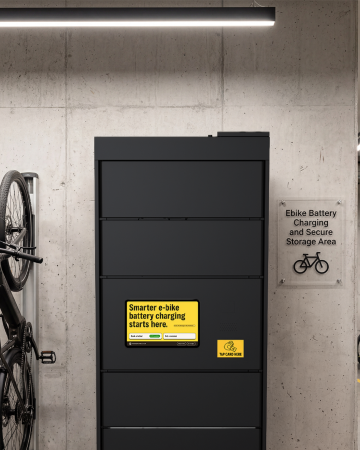
The battery and its charger go inside and charge behind a locked door. Each bay is lined with mica sheeting and monitored for current draw, temperature, and smoke. If readings drift, the system shuts that locker down and alerts the operator. If a fire starts, a suppressant quenches it inside the compartment. Put the unit outdoors and you get one more advantage, because a burning battery is exactly where fire crews would want it anyway.
Wondering what safe charging looks like in your building? Get in touch, or learn more about PowerShelter in Canada.
Mark Marmer spoke with Chris Glover on CBC Radio’s Metro Morning, August 6, 2026.