


Why E-Bike Battery Fires Demand Better Infrastructure
A bus shelter ad in Toronto stopped us in our tracks.
Bold yellow warning triangle. Explosion graphic. The message: “Overcharging a lithium-ion battery could harm your family. Always keep your e-bike battery in sight while charging.”
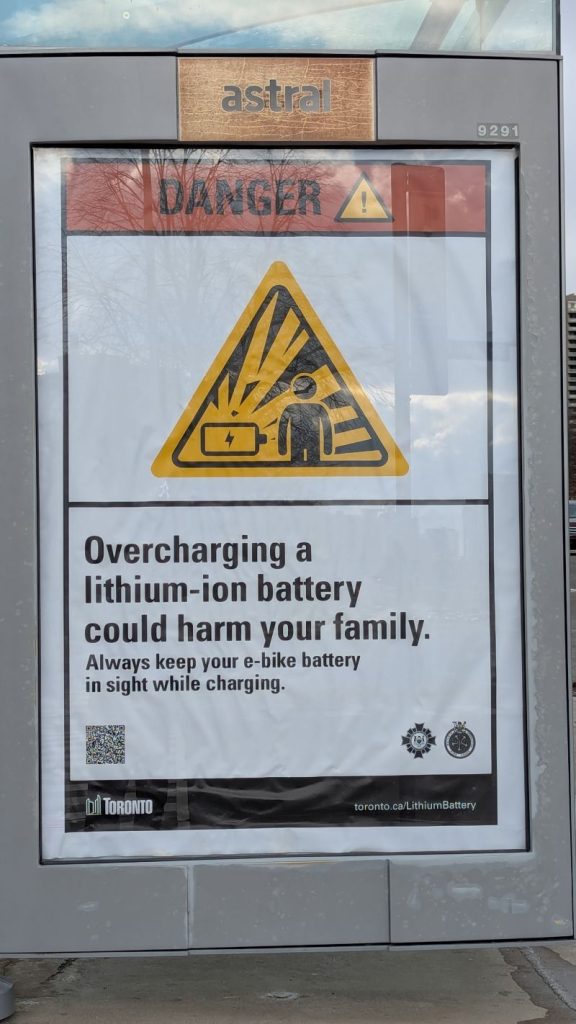
Clearly, the City of Toronto has identified a real problem that needs a solution.
At Signature Electric, we often hear concerns about fires involving electric vehicles. While lithium-ion battery fires in cars can be challenging to extinguish, the greater and more immediate risk may actually come from e-bikes and other micromobility devices.
The scale of the problem
E-bike and e-scooter fires have become a growing concern in urban centers across North America. In New York City alone, lithium-ion battery fires from micromobility devices caused 268 fires, 150 injuries, and 18 deaths in 2023. Toronto Fire Services has reported a similar uptick in incidents, prompting the city’s public awareness campaign.
By comparison, electric vehicle fires remain statistically rare. While EV fires generate headlines, they occur at a lower per capita rate than gasoline-powered vehicle fires. The key difference isn’t the technology itself, but how and where these batteries are being charged.
Why e-bike batteries pose unique challenges
Not all lithium-ion batteries are created equal.
Electric vehicles use sophisticated battery management systems (BMS) with multiple layers of protection. These systems constantly monitor temperature, voltage, and cell balance. They’re designed with thermal runaway prevention, automatic shut-offs, and are tested to rigorous automotive safety standards. EV batteries are also housed in reinforced, crash-tested enclosures with built-in cooling systems.
E-bike and e-scooter batteries, particularly aftermarket or budget models, often lack these advanced safety features. They’re frequently charged with generic adapters that may not match the battery’s specifications. And critically, they’re being charged in living spaces, like on kitchen counters, in bedrooms, or near exits, rather than in controlled environments.
The Toronto Fire Services warning highlights this reality. When a lithium-ion battery enters thermal runaway, it can release toxic gases, reach temperatures exceeding 1,000°C, and ignite surrounding materials in seconds. In a small urban apartment or condo unit, the consequences can be catastrophic.
The limits of education alone
The City’s guidance on safe use, charging, and storage includes important recommendations:
- Never modify or tamper with your battery
- Keep your battery in sight while charging, and unplug it once charging is complete
- Do not charge devices on soft surfaces like beds, couches, or under pillows
- Store lithium-ion batteries at room temperature
- Avoid direct sunlight or leaving batteries in hot vehicles
- Avoid damp or highly humid environments
- Store batteries away from flammable materials
- Avoid crushing, bending, or dropping devices or chargers
- If a battery or device sparks or smokes, call 911 and if safe, move it outside and away from anything combustible
These are sensible precautions. But instructions like “store lithium-ion batteries away from anything that can catch fire” reveal a fundamental challenge. In a 600-square-foot condo, where exactly is that supposed to be?
Consider the reality for many urban residents:
- A delivery worker charging three e-bike batteries overnight in a one-bedroom apartment
- A family storing e-scooters in a shared hallway because there’s nowhere else
- Students charging devices in cluttered dorm rooms
- Condo residents with limited storage options and no dedicated utility spaces
Education is a critical first step. But behavioural guidelines alone won’t solve an infrastructure problem.
What can buildings do?
The solution isn’t to discourage micromobility adoption. E-bikes and e-scooters are valuable tools for urban transportation, last-mile delivery, and carbon emissions reduction. The solution is to create environments where these devices can be charged safely.
For condos and multi-unit residential buildings, that means rethinking charging infrastructure:
Dedicated charging rooms
Purpose-built spaces designed specifically for charging micromobility devices offer the safest option. These rooms should include:
- Fire-rated construction and proper ventilation
- Dedicated electrical circuits with appropriate amperage
- Fire suppression systems
- Temperature monitoring
- Secured access to prevent tampering
- Clear separation from residential units and primary egress routes
These aren’t theoretical concepts. Progressive buildings in cities like Amsterdam and Copenhagen have already implemented dedicated e-bike charging facilities as standard amenities.
Charging lockers
For buildings that can’t accommodate a full charging room, purpose-built charging lockers offer a practical middle ground. Companies like PowerShelter manufacture enclosed battery lockers specifically designed for e-bikes and e-scooters, with safety built in from the ground up. Their units come in configurations suited for both managed residential properties and high-traffic outdoor environments. Benefits of charging lockers include:
- Containment of any thermal event to a single, isolated unit
- No permanent construction required
- Remote monitoring and API connectivity for building managers
- Flexible access control via individual codes, shared keys, or fleet management integration
- Scalable deployment as resident demand grows
Signature Electric has become a Canadian partner with PowerShelter. Learn more here.
Outdoor charging stations
For buildings with ground-level access or parking areas, weather-protected outdoor charging stations provide another solution. Benefits include:
- Physical separation from living spaces
- Natural ventilation
- Reduced risk to building occupants in case of thermal events
- Potential for integrated bike storage
- Opportunity to incorporate renewable energy sources
Electrical system upgrades
Many older buildings weren’t designed for the electrical load required by multiple high-capacity battery charging operations. Upgrading electrical infrastructure might include:
- Panel capacity assessments and upgrades
- Dedicated circuits for charging areas
- Smart load management systems
- Ground fault protection
Policy and design integration
Buildings can also implement clear policies that balance safety with practicality:
- Designated charging areas only
- Approved charger requirements
- Regular inspections of charging equipment
- Clear protocols for battery disposal
- Integration of charging infrastructure into building renovation plans
For new construction, incorporating micromobility charging infrastructure from the design phase is far more cost-effective than retrofitting later.
The bigger picture
This issue extends beyond individual safety concerns. As cities push for reduced emissions and increased adoption of electric transportation, we need infrastructure that can support that transition safely.
The same principle applies to the broader electrification movement. You can’t mandate electric vehicle adoption without ensuring buildings have adequate charging infrastructure. You can’t encourage e-bike commuting without providing safe places to charge those bikes. Education matters, but infrastructure makes it possible.
The bus shelter ad is doing important work raising awareness. But awareness alone won’t keep people safe in buildings that weren’t designed for how we live and move today.
Real solutions require investment in electrical infrastructure, thoughtful building design, and proactive planning from property managers and condo boards. It means treating charging infrastructure not as an afterthought, but as essential building systems—like elevators, fire alarms, and emergency lighting.
Moving forward
For building managers, condo boards, and property owners wondering where to start:
- Assess current practices – Where are residents charging devices now? What risks exist?
- Evaluate electrical capacity – Can your building support dedicated charging infrastructure?
- Explore space options – What areas could be converted or designed for safe charging?
- Engage experts – Work with electrical contractors who understand both the technical requirements and the building code implications
- Plan incrementally – Even small improvements (dedicated outlets, clear policies, improved ventilation) make a difference
The shift to electric transportation is here. E-bikes, e-scooters, and electric vehicles are becoming more common. The question isn’t whether buildings need to adapt—it’s how quickly they can do so safely.
Education campaigns like Toronto’s are raising awareness of the risks. Now it’s time to build the infrastructure that makes safe charging practical, accessible, and routine.
Because the best safety guideline isn’t “keep your battery in sight while charging.” It’s “charge your battery in a space designed for exactly that purpose.”
Ready to assess your building’s electrical infrastructure for safe micromobility charging? Signature Electric specializes in helping condos and multi-unit buildings plan, design, and implement charging solutions that prioritize both safety and practicality. Learn more about our condo services →